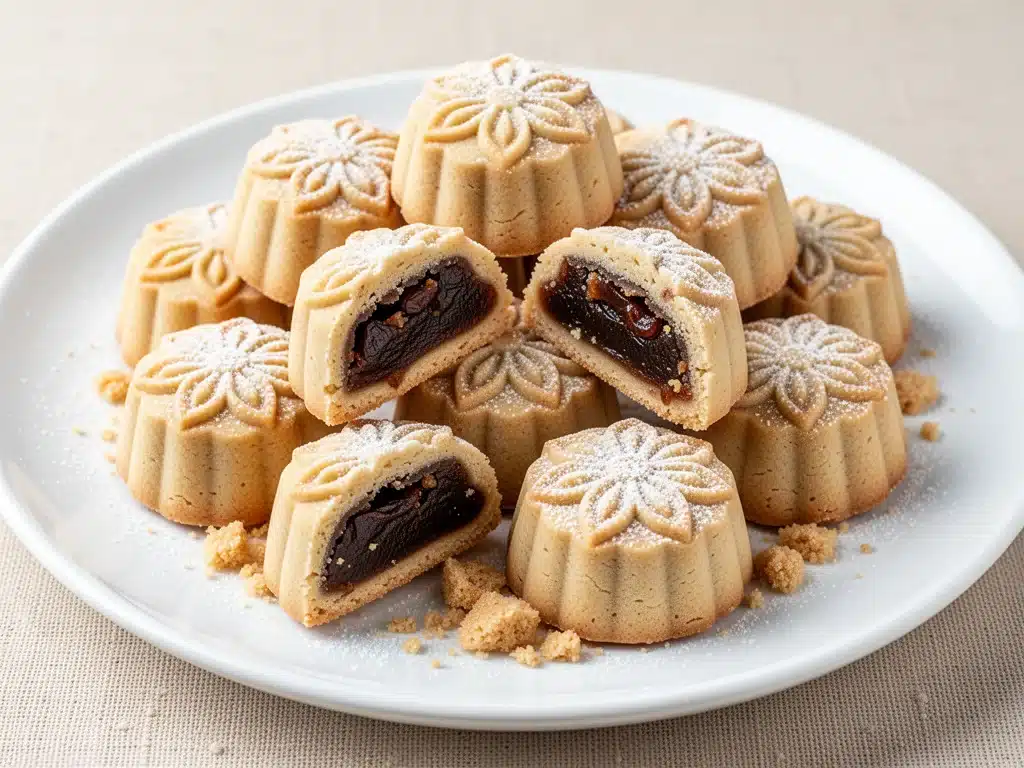
There is a specific kind of magic that happens in my kitchen when the Eid season approaches. It’s not just about the sugar or the spices; it’s about the rhythm. The rhythmic thud of the wooden mallet against the dough. The scent of rose water drifting through the hallway. And the quiet, focused silence of three generations sitting around a table, shaping tiny crescents of dough that hold the sweetest surprises inside.
I remember my first attempt at making traditional ma’amoul cookies like it was yesterday. I was twenty-two, living in my first apartment, and I thought, “How hard can it be? It’s just flour, butter, and date paste.” I was so wrong. My first batch came out cracked, dry, and completely devoid of that beautiful, smooth finish I’d seen in my grandmother’s hands. They tasted okay, but they looked like little rocks. I felt defeated. I almost ordered store-bought ones, but my grandmother called and asked if I was coming over for tea. I showed her my sad, cracked cookies, and she just laughed, wiped the flour off my nose, and said, “You’re rushing the dough. It needs to rest. It needs to breathe.”
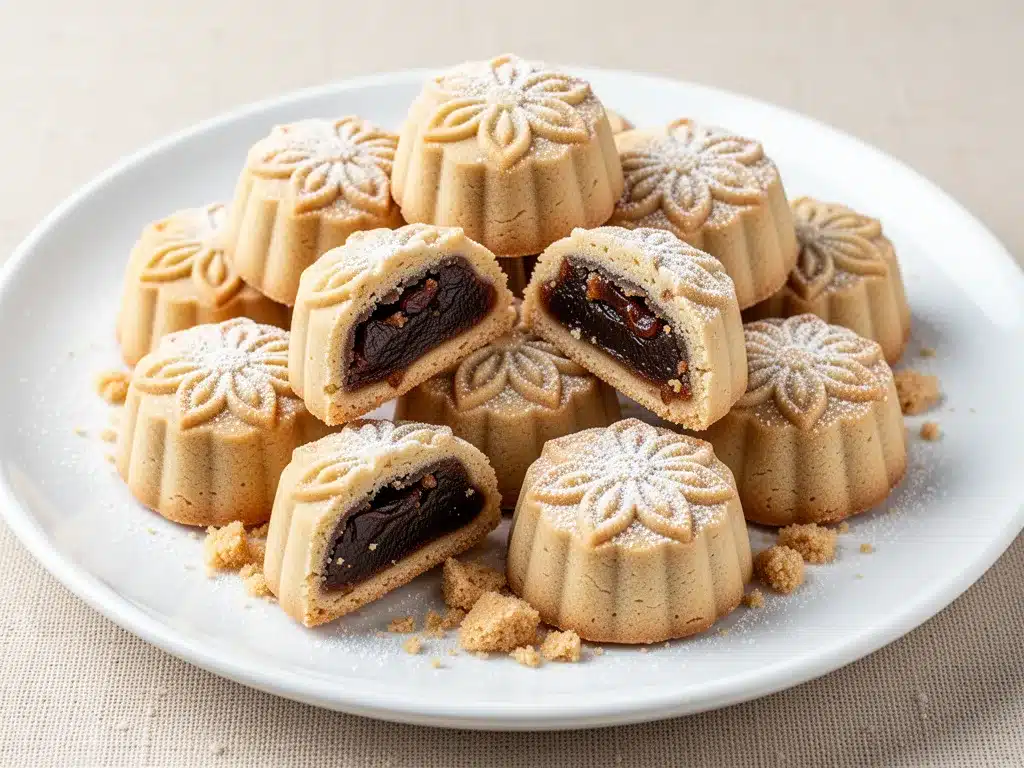
That was the lesson. Ma’amoul isn’t just a recipe; it’s a practice in patience. It’s a cookie that demands your attention but rewards you with the most delicate, melt-in-your-mouth texture you’ll ever experience. The shell is crisp on the outside and tender on the inside, while the date filling is rich, dark, and deeply aromatic.
After years of tweaking—adjusting the butter ratio, learning the perfect consistency for the date paste, and mastering the art of the mold—I finally nailed it. This version is the one I’ve been making for the last decade. It’s forgiving enough for beginners but authentic enough to pass my grandmother’s strict inspection. Whether you’re making these for Eid, a special dinner party, or just because you want to treat yourself to something truly special, these traditional ma’amoul cookies are worth the effort. And trust me, once you try the date filling, you might never go back to the semolina and pistachio version (though that’s good too).
Why You’ll Love This Ma’amoul Recipe
There are about ten reasons I keep coming back to these cookies, but here are the big ones that will win you over.
- Impossibly Tender Texture — These aren’t dense, heavy cookies. They are light, airy, and practically dissolve on your tongue. The secret is the resting time for the dough, which relaxes the gluten and ensures that perfect crumb. I’ve tested this with both all-purpose flour and semolina, and this specific blend gives the best result.
- Complex, Not Just Sweet — The date filling is balanced with orange blossom water and a pinch of cardamom. It’s not cloying. It’s sophisticated. It tastes like a high-end Middle Eastern patisserie, not a grocery store bakery.
- Make-Ahead Friendly — You can make the date filling days in advance. In fact, it gets better as it sits. The dough can also be refrigerated for up to three days. This is perfect for holiday prep when you’re overwhelmed.
- Stunning Visuals — Using a ma’amoul mold (or even a simple fork if you’re improvising) creates beautiful patterns that look impressive on any serving platter. They are as beautiful as they are delicious.
- Gluten-Free Option — By using fine semolina instead of all-purpose flour, you can make these naturally gluten-free without sacrificing texture. I often make a batch just for my gluten-free sister, and she says they taste exactly like the ones from her childhood.
This recipe has become my go-to for any celebration. It’s my answer to “what dessert should I bring?” when I want to show up with something that feels traditional, heartfelt, and handmade.
Ingredients You’ll Need for Traditional Ma’amoul
Here’s the thing about ma’amoul: the quality of your ingredients matters more than anything. Since there are so few components, each one shines. I’m particular about three things here: the butter, the dates, and the floral waters.
For the Date Filling
Medjool dates (2 cups, pitted / about 300g) — These are non-negotiable. They are large, soft, and naturally sweet. If you can’t find Medjool, use Deglet Noor, but you’ll need to soak them longer. Do not use the small, dry dates from the produce section; they won’t blend smoothly.
Orange blossom water (1 tablespoon) — This is the soul of Middle Eastern baking. It adds a floral note that pairs perfectly with dates. If you can’t find it, rose water works, but orange blossom is more traditional for the filling. Use the real stuff, not the artificial “flavoring” from the perfume aisle.
Ground cinnamon (1 teaspoon) — Just a hint. You want warmth, not a pumpkin spice vibe.
Ground cardamom (½ teaspoon) — This adds that authentic, slightly peppery floral note. If you don’t have it, you can skip it, but it’s highly recommended.
Butter (2 tablespoons / 30g) — Softened. This helps bind the dates and adds richness to the filling.
For the Dough
Fine semolina flour (2 cups / 250g) — This is what gives ma’amoul its signature texture. It’s coarser than all-purpose flour but finer than coarse semolina. Look for “fine” or “super fine” semolina. If you can’t find it, you can pulse regular semolina in a food processor until it’s dust-like.
All-purpose flour (1 cup / 125g) — I use a mix of semolina and all-purpose flour. Pure semolina can be too crumbly, and pure all-purpose lacks the traditional texture. This blend is the sweet spot.
Unsalted butter (1 cup / 225g, softened) — Yes, a whole cup. The dough is rich. Use good quality butter. If your butter is too cold, the dough will be tough. Room temperature is key.
Yogurt (½ cup / 120g) — Plain, full-fat yogurt. This tenderizes the dough and adds a slight tang that balances the sweetness. Some recipes use milk, but yogurt gives a better crumb.
Sugar (½ cup / 100g) — Adjust based on how sweet your dates are. If your dates are very sweet, reduce to ¼ cup.
Vanilla extract (1 teaspoon) — For depth.
Orange blossom water (2 tablespoons) — For the dough, this adds a subtle floral background note.
Baking powder (1 teaspoon) — Just a little bit to help them puff slightly.
Salt (½ teaspoon) — To balance the sweetness.
For Decoration (Optional)
Confectioners’ sugar — For dusting. Some people dust them after baking, but I prefer to dust them lightly before baking for a matte finish.
Egg wash (1 egg beaten with 1 tablespoon milk) — Optional, but it gives them a slight shine and helps the sugar adhere if you’re dusting after.
Equipment Needed
You don’t need fancy gadgets, but having the right tools makes this so much easier.
Food processor — Essential for blending the dates into a smooth paste. Do not try to mash dates by hand. It will take forever and your arms will hurt.
Ma’amoul molds — These are wooden or plastic molds with intricate patterns. You can find them online or in Middle Eastern markets. If you don’t have them, you can use a fork to make a crisscross pattern, but the shapes won’t be as pretty. I have a set of three: crescent, circle, and square.
Mixing bowls — One large bowl for the dough, one medium for the filling.
Parchment paper — For lining baking sheets. These cookies are delicate and can stick if you’re not careful.
Silicone spatula — For scraping down the bowl and mixing the dough.
Pastry brush — If you’re doing an egg wash or brushing with syrup.
How to Make It: Step-by-Step
Alright, let’s make these beauties! I’m walking you through exactly how I do it, including the little tricks I’ve picked up over the years.
Step 1: Make the Date Filling (15 minutes)
Start with the filling because it needs time to cool and firm up. In your food processor, combine the pitted dates, orange blossom water, cinnamon, cardamom, and softened butter. Pulse until the dates are broken down, then process for 2-3 minutes until you have a smooth, sticky paste. If it’s too dry and won’t come together, add a teaspoon of warm water at a time. If it’s too wet, add a few more dates. The consistency should be like playdough—firm enough to hold its shape but soft enough to spread. Transfer to a bowl, cover with plastic wrap, and let it sit at room temperature while you make the dough.
Step 2: Prepare the Dough (10 minutes)
In a large mixing bowl, combine the semolina flour, all-purpose flour, baking powder, and salt. Whisk to combine. Add the softened butter, yogurt, sugar, vanilla, and orange blossom water. Mix with a wooden spoon or your hands until the dough comes together. It should look like coarse sand at first, then clump together. Knead it in the bowl for about 5 minutes. The dough should be smooth, pliable, and not sticky. If it’s too dry, add a tablespoon of milk. If it’s too sticky, add a tablespoon of flour. This is the most important step—don’t rush the kneading.
Step 3: Rest the Dough (1 hour)
Once the dough is smooth, cover it tightly with plastic wrap or put it in an airtight container. Let it rest at room temperature for at least 1 hour. This allows the semolina to hydrate fully, which prevents cracking during baking. I often let it rest for 2 hours if I’m not in a hurry. The dough will become softer and more elastic.
Step 4: Shape the Cookies (20-30 minutes)
Take a small piece of dough (about the size of a walnut) and flatten it in your palm. Place a small amount of date filling (about 1 teaspoon) in the center. Carefully fold the dough over the filling, sealing it completely. Roll it into a smooth ball. Make sure there are no cracks! If you see cracks, press them shut with your fingers. Repeat with the rest of the dough and filling.
Now, the fun part: molding. Lightly dust your ma’amoul mold with confectioners’ sugar or flour. Place the dough ball into the mold, pattern side up. Press down firmly with your thumb or a small tool until the dough fills the mold completely. Turn the mold over onto a parchment-lined baking sheet. Tap the bottom gently, and the cookie should pop out with a beautiful pattern. If it sticks, your mold wasn’t dusted enough, or the dough is too sticky. Add a little more flour to the dough or the mold.
Step 5: Bake (15-18 minutes)
Preheat your oven to 350°F (175°C). If you’re brushing with egg wash, do it now. Bake for 15-18 minutes, or until the cookies are lightly golden on the bottom and sides. They should not be dark brown. They are delicate, so watch them closely. The edges might puff up slightly, which is normal.
Step 6: Cool and Serve
Let the cookies cool on the baking sheet for 5 minutes, then transfer them to a wire rack to cool completely. They will firm up as they cool. Dust with confectioners’ sugar if desired. Serve with strong Arabic coffee or tea. The contrast of the sweet cookie and bitter coffee is perfection.
Expert Tips & Tricks for Perfect Ma’amoul
Here’s everything I’ve learned from making these dozens of times. These tips will save you from my mistakes.
- Don’t Skip the Resting Time — I know it’s tempting to start shaping immediately, but the dough needs time to hydrate. If you bake it too soon, the cookies will crack and fall apart. Let it rest for at least an hour.
- Keep the Dough Covered — Semolina dries out quickly. Keep your dough covered with a damp cloth or plastic wrap while you’re shaping. If it dries out, it will crack in the mold.
- Use the Right Amount of Filling — Too much filling, and it will leak out during baking. Too little, and you won’t taste it. Aim for a 2:1 ratio of dough to filling. A walnut-sized ball of dough with a teaspoon of filling is the sweet spot.
- Dust Your Mold Generously — This is the #1 reason cookies stick. Use confectioners’ sugar or flour. Tap out the excess. If the cookie sticks, your mold needs more dusting.
- Low and Slow — Bake at 350°F. Higher heat will brown the outside too quickly while the inside remains raw. You want a gentle bake to keep them tender.
Variations & Substitutions
Once you’ve mastered the basic date version, here’s how you can mix it up. I’ve tried all of these.
Walnut & Pistachio Ma’amoul — Instead of date filling, use crushed walnuts mixed with sugar and orange blossom water. Top with a pistachio half before baking. This is the most traditional version in many households.
Black Sesame Ma’amoul — Add 2 tablespoons of black sesame paste to the dough for a beautiful gray color and nutty flavor. This is popular in Palestinian and Syrian households.
Sugar-Free Date Filling — Use unsweetened dates and skip the added sugar in the dough. The dates are naturally sweet enough. I make this for my diabetic uncle, and he loves it.
Gluten-Free Version — Use 100% fine semolina instead of the mix. The texture will be slightly more crumbly, but still delicious. Just be extra careful with the resting time.
Vegan Version — Substitute the butter in the dough with vegan butter or coconut oil. Use agave nectar instead of sugar in the filling if needed. The yogurt can be replaced with coconut yogurt.
Serving & Storage
How to Serve: I usually serve these on a beautiful platter with Arabic coffee. They are also great with black tea or chai. The date filling pairs well with strong, bitter coffee, which cuts through the sweetness.
Storage: Store in an airtight container at room temperature for up to 2 weeks. They actually get better after a day or two as the flavors meld. If it’s humid, keep them in the fridge, but let them come to room temperature before serving.
Freezing: Yes, you can freeze them! Bake them, let them cool completely, then freeze in an airtight container for up to 3 months. Thaw at room temperature. Do not freeze the dough with filling inside; it’s better to freeze the baked cookies.
Pro Tip: If the cookies start to dry out, place a slice of bread in the container with them. The bread will release moisture and keep the cookies soft.
Nutrition Information
I’m not a nutritionist, but here’s the breakdown if you’re tracking. Ma’amoul are rich cookies, so moderation is key.
Per Cookie (based on 30 cookies):
- Calories: 120
- Protein: 2g
- Carbs: 18g
- Fiber: 1g
- Sugar: 10g
- Fat: 5g
These are higher in calories due to the butter and dates, but they are also more filling than standard sugar cookies. The dates provide natural sugars and fiber. If you’re watching your sugar intake, use unsweetened dates and reduce the sugar in the dough.
Final Thoughts
So that’s my go-to traditional ma’amoul recipe! I’ve probably talked your ear off at this point, but when you make a recipe this often, you have a lot to say about it. These cookies have saved my holiday presentations more times than I can count. They’re my answer to “what dessert should I bring?” when I want to show up with something that feels traditional, heartfelt, and handmade.
Make it yours! Try different fillings, swap in your favorite nuts, adjust the spices to your taste. The best recipes are the ones you adapt to your family’s tastes. If you make this, drop a comment and let me know what you think! I love hearing how recipes turn out in your kitchen. And if something doesn’t work, tell me that too—I’m here to help troubleshoot.
Happy baking! And I hope your kitchen smells half as good as mine does right now.
Frequently Asked Questions
Can I use all-purpose flour instead of semolina?
You can, but the texture will be different. Pure all-purpose flour will make the cookies softer and less crumbly, more like a shortbread. Semolina gives that traditional, slightly gritty, melt-in-your-mouth texture. If you must use all-purpose, I recommend using half all-purpose and half semolina for the best result.
Why did my ma’amoul cookies crack?
Cracking usually happens for two reasons: the dough was too dry, or you didn’t let it rest long enough. If the dough is dry, add a little more yogurt or milk. If you didn’t let it rest, the semolina didn’t have time to hydrate. Next time, let it rest for at least 2 hours. Also, make sure you’re sealing the filling completely inside the dough.
Can I make the date filling ahead of time?
Yes! In fact, it’s better if you make it ahead. The filling can be stored in an airtight container in the fridge for up to 2 weeks. Let it come to room temperature before shaping the cookies. You can also freeze the filling for up to 3 months.
Do I have to use a ma’amoul mold?
No, you don’t. You can shape them into balls or crescents and press a fork into them for a simple pattern. However, the molds create those beautiful, intricate designs that are traditional for Eid. If you don’t have a mold, you can buy them online or in Middle Eastern markets for a few dollars.
Can I freeze the dough?
Yes, you can freeze the dough. Wrap it tightly in plastic wrap and freeze for up to 3 months. Thaw it in the fridge overnight before shaping. Note that the texture might be slightly different after freezing, so it’s best to use fresh dough if possible.
What is the difference between ma’amoul and ka’ak?
Ma’amoul are filled cookies, usually with dates or nuts. Ka’ak are similar but often have a different dough texture (sometimes with sesame seeds on top) and may or may not be filled. In some regions, the terms are used interchangeably, but traditionally, ma’amoul are the filled ones.
Pin This Recipe!
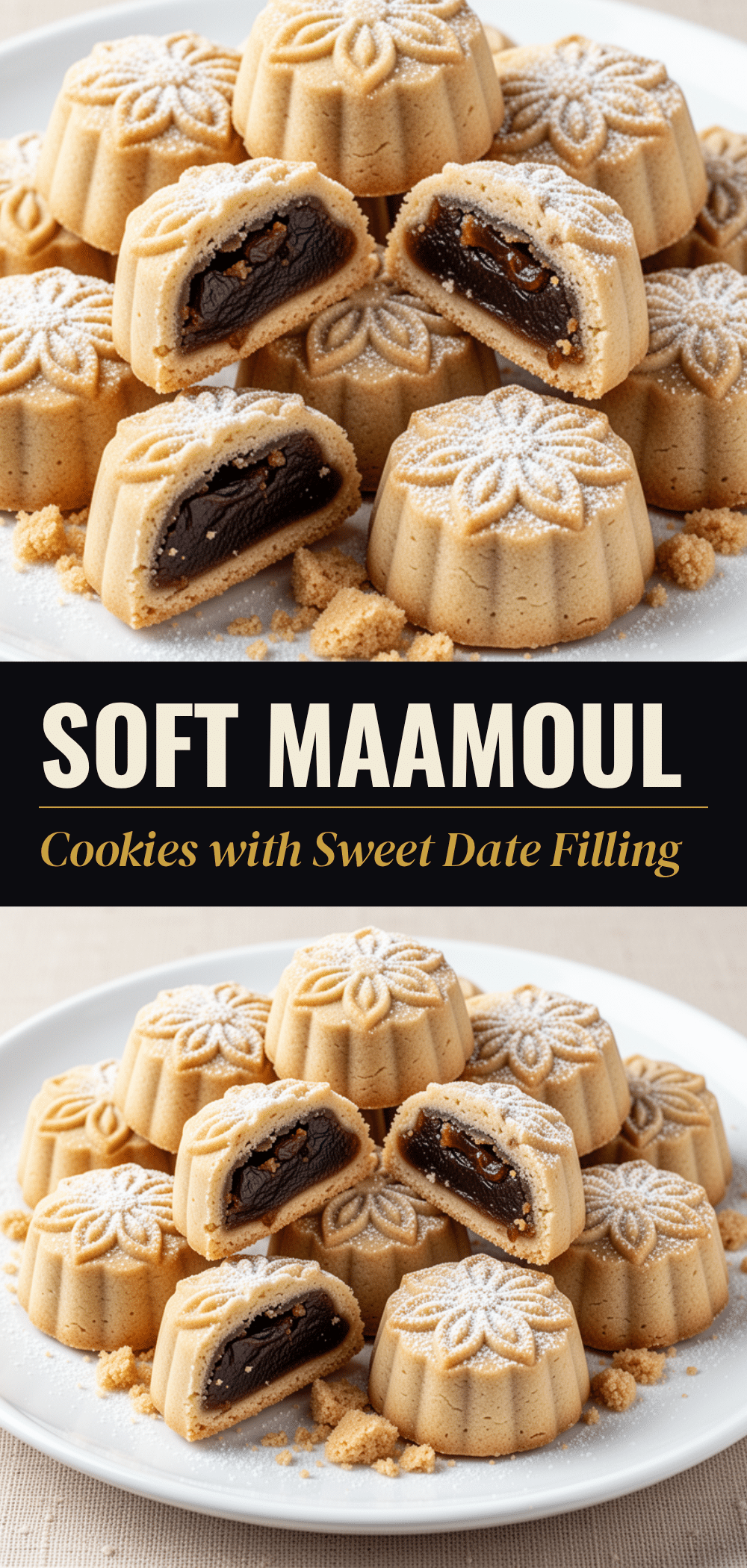
Traditional Maamoul Cookies: Best Easy Eid Date Filling
- Total Time: 1 hour 45 minutes
- Yield: 30 cookies 1x
Description
These traditional ma’amoul cookies feature a tender, melt-in-your-mouth semolina dough filled with a rich, aromatic date paste infused with orange blossom water and cardamom. Perfect for Eid or any celebration, this recipe balances authenticity with beginner-friendly techniques.
Ingredients
- For the Date Filling:
- 2 cups Medjool dates, pitted (about 300g)
- 1 tablespoon orange blossom water
- 1 teaspoon ground cinnamon
- ½ teaspoon ground cardamom
- 2 tablespoons unsalted butter, softened
- For the Dough:
- 2 cups fine semolina flour (250g)
- 1 cup all-purpose flour (125g)
- 1 cup unsalted butter, softened (225g)
- ½ cup plain, full-fat yogurt (120g)
- ½ cup sugar (100g)
- 1 teaspoon vanilla extract
- 2 tablespoons orange blossom water
- 1 teaspoon baking powder
- ½ teaspoon salt
- For Decoration (Optional):
- Confectioners’ sugar, for dusting
- 1 egg beaten with 1 tablespoon milk, for egg wash
Instructions
- Make the Date Filling: In a food processor, combine pitted dates, orange blossom water, cinnamon, cardamom, and softened butter. Pulse until broken down, then process for 2-3 minutes until a smooth, sticky paste forms. If too dry, add warm water; if too wet, add more dates. Transfer to a bowl, cover, and let sit at room temperature.
- Prepare the Dough: In a large bowl, whisk together semolina flour, all-purpose flour, baking powder, and salt. Add softened butter, yogurt, sugar, vanilla, and orange blossom water. Mix until it resembles coarse sand, then knead for 5 minutes until smooth and pliable. Adjust with milk or flour if needed.
- Rest the Dough: Cover the dough tightly with plastic wrap or place in an airtight container. Let rest at room temperature for at least 1 hour (up to 2 hours) to allow the semolina to hydrate fully.
- Shape the Cookies: Take a walnut-sized piece of dough, flatten it, and place a teaspoon of date filling in the center. Fold the dough over the filling, sealing it completely, and roll into a smooth ball. Ensure there are no cracks.
- Mold the Cookies: Lightly dust a ma’amoul mold with confectioners’ sugar or flour. Place the dough ball into the mold, pattern side up. Press firmly, turn over onto a parchment-lined baking sheet, and tap gently to release the cookie.
- Bake: Preheat oven to 350°F (175°C). Brush cookies with egg wash if desired. Bake for 15-18 minutes until lightly golden on the bottom and sides. Do not let them brown too much.
- Cool and Serve: Let cookies cool on the baking sheet for 5 minutes, then transfer to a wire rack to cool completely. Dust with confectioners’ sugar if desired. Serve with Arabic coffee or tea.
Notes
The dough must rest for at least one hour to prevent cracking. Keep the dough covered while shaping to prevent drying out. Use fine semolina for the best texture. The date filling can be made days in advance and stored in the fridge. Store finished cookies in an airtight container at room temperature for up to 2 weeks.
- Prep Time: 45 minutes
- Cook Time: 18 minutes
- Category: Dessert
- Cuisine: Middle Eastern
Nutrition
- Serving Size: 1 cookie
- Calories: 120
- Sugar: 10
- Sodium: 50
- Fat: 5
- Saturated Fat: 3
- Carbohydrates: 18
- Fiber: 1
- Protein: 2
Keywords: maamoul, eid cookies, date filling, semolina cookies, middle eastern dessert, traditional cookies, easy maamoul, eid al-fitr